
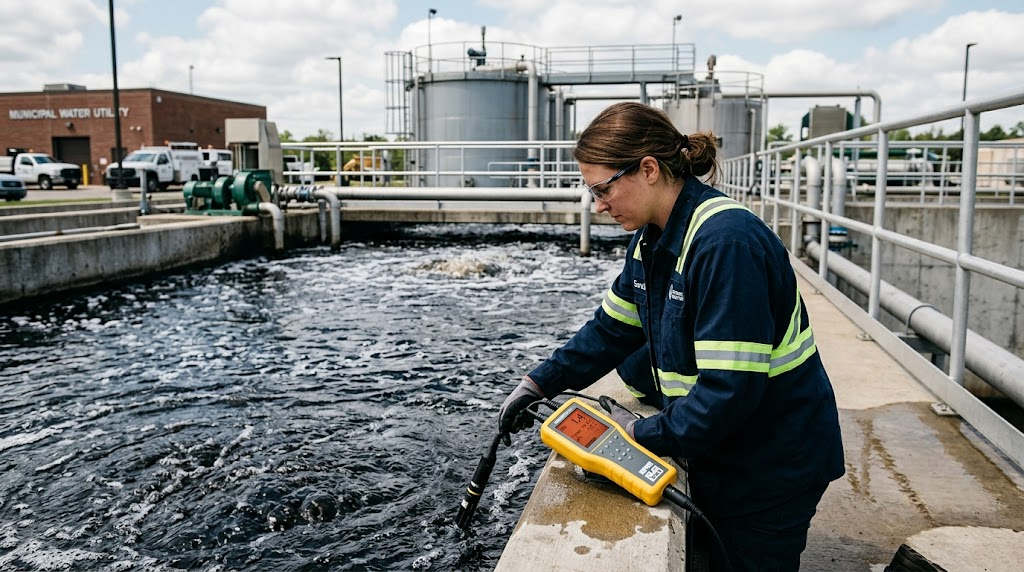
Water utilities operate complex systems daily. They monitor treatment performance, energy consumption, maintenance, and water quality. But one factor often deserves more attention: oxygen levels.
Biological activity, water chemistry, treatment efficiency, and infrastructure may be influenced by low dissolved oxygen. These effects can compound operation costs over the long term. Thus, knowledge of water DO can be beneficial for utilities to optimize system performance and minimize costs.
Excessive oxygen depletion can cause difficult conditions in water systems. Some of these include odor, corrosion, unstable biological treatment , and inefficient processes. Fortunately, utilities can take proactive measures to address and control these risks.
Dissolved oxygen (DO) is the amount of oxygen gas dissolved in water. It is beneficial to aquatic organisms and numerous biological processes in water and wastewater treatment .
Healthy oxygen levels can support aerobic microorganisms. They aid in the decomposition of organic matter and in important treatment processes. Anaerobic activity can be encouraged, in contrast, when the conditions are depleted of oxygen.
Oxygen can be impacted by temperature, pressure, biological activity, organic loading, and water movement. Thus, utilities are encouraged to measure dissolved oxygen in water as they meet their application.
When a utility considers costs, they tend to consider the obvious costs like electricity, chemicals, labor, and equipment. Less visible costs may be incurred due to dissolved oxygen problems.
These problems may develop gradually. As a result, operators may not immediately connect them with oxygen levels.
Each expense may appear manageable on its own. However, repeated issues can create high costs over months and years.
When oxygen becomes depleted, anaerobic conditions can develop. These conditions can change biological and chemical processes within water systems.
Under special conditions, hydrogen sulfide can be produced in the absence of oxygen. It may be linked to bad smells and may pose further management issues.
Low and/or anoxic conditions may also facilitate anaerobic digestion, hydrogen sulfide production, acid formation, and additional pH decrease.
Consequently, preventing oxygen depletion can help utilities maintain more predictable operating conditions.
Aeration remains an important method for adding oxygen to water. However, oxygen transfer efficiency matters just as much as air delivery.
Traditional fine-bubble aeration introduces air into water. Yet air contains gases beyond oxygen. PUROXI explains that nitrogen and carbon dioxide can also dissolve during conventional aeration.
This factor deserves consideration when utilities evaluate their oxygen-transfer systems.
Instead of simply adding more air, operators should determine whether their system transfers oxygen efficiently.

Early monitoring can help utilities identify changing conditions before they become expensive.
Operators can track DO alongside temperature, biological demand, flow, and other relevant water-quality measurements. This approach can reveal patterns and unusual changes.
For example, declining oxygen may indicate increased biological demand. It may also reflect changing temperatures, insufficient mixing, or altered organic loading.
Early action can also prevent small oxygen-related concerns from becoming larger operational challenges.
Effective water oxygenation solutions should match the application. Every water system has different conditions, oxygen requirements, flow rates, and treatment objectives.
Therefore, utilities should avoid selecting equipment based only on general specifications.
A properly designed system can help utilities address oxygen requirements without unnecessarily increasing operating demands.
Technology can support applications involving wastewater, drinking water, ponds, aquaculture, bioreactors, and other water-treatment environments.
Another option involves generating oxygen on-site.
PUROXI’s oxygen generators use PSA technology and can provide concentrated oxygen for applications such as water treatment and ozone production. The company lists models with oxygen concentrations of up to 96% and emphasizes low energy consumption.
PUROXI also offers nano-bubble technology . Its systems are designed for efficient gas-liquid mixing and oxygen transfer across applications such as wastewater treatment and aquaculture.
Improving oxygen management can support more than water quality. It can also help utilities improve operational control.
Actual savings will depend on site conditions and system design. Still, measuring oxygen demand and transfer efficiency can help utilities make better investment decisions.
Before purchasing new equipment, utilities should evaluate their existing system. Start with water-quality measurements and identify areas where oxygen depletion occurs.
Next, review current aeration equipment and energy consumption. Then, determine whether the existing system provides adequate oxygen transfer.
Modern water oxygenation solutions can include oxygen generators, aeration equipment, and nano-bubble technologies.
The right choice depends on the application’s requirements.
Water utilities cannot afford to overlook oxygen conditions. Low dissolved oxygen (DO) can impact biologic activity, water chemistry, odor, maintenance, and treatment performance.
However, utilities have a solution—take a proactive approach. A combination of regular testing and suitable oxygen transfer strategies can help operators gain an understanding of changes in conditions.
Most importantly, dissolved oxygen in water should not be treated as just another measurement. It can provide valuable insight into system health and treatment efficiency.
By addressing dissolved oxygen problems early, utilities can improve process control and potentially reduce avoidable operational costs. The right water oxygenation solutions can further support efficient and sustainable water management.
Don’t let oxygen-related issues quietly increase your utility’s operating costs. Evaluate your current oxygen levels, identify potential inefficiencies, and explore technologies designed around your treatment goals.
For customized oxygenation, water treatment, and oxygen-transfer solutions, Puroxi offers technologies for municipal, industrial, agricultural, and other water-treatment applications. Explore PUROXI’s solutions to find a practical approach for improving oxygen management and overall water-treatment performance.
Low dissolved oxygen can increase energy use, maintenance needs, odor control, and treatment challenges.
Dissolved oxygen in water supports aerobic microorganisms that help break down organic matter during biological treatment.
Common dissolved oxygen problems include anaerobic conditions, odors, unstable treatment, and changing water chemistry.
Modern water oxygenation solutions include oxygen generators, aeration, and nanobubble technologies.
Better oxygen management may reduce energy waste, maintenance demands, odor issues, and inefficient treatment operations.

Puroxi Pure Water Global Inc was shortlisted for the awards category, Water Solutions Provider of the Year! As highlighted, it was some good news. I can confirm you that you have been chosen as the 2023/24 winners. Congratulations Zak! The generic winner’s logo has been attached which you can utilize to promote the recognition and the official press release will be conducted in March (defined date to come
© 2026 PUROXI. All Rights Reserved.
Crafted with Love: DigiCorns

Contact Us